
Most supplier pages present full turnkey, partial turnkey and consigned assembly as three service tiers. They are not tiers. They are three different allocations of purchasing responsibility, material ownership and shortage risk — and the difference shows up in the quotation, in the schedule, and in the conversation that happens when a reel arrives short.
A buyer who compares full turnkey vs partial turnkey PCB assembly on price per board will usually choose the option that looks cheapest and then discover where the cost went: into material they now have to buy, store, kit, insure and ship. The useful question is not which model is cheaper. It is which party can actually buy the parts, at what price and on what terms, and who absorbs the consequences when the BOM does not go to plan. That is the whole of the turnkey vs consigned PCB assembly question, and it is settled by the purchase order rather than by the service description.
This guide breaks the decision into six places where responsibility moves — purchasing, price risk, shortage handling, incoming material, surplus, and warranty — and shows what each shift does to your quotation and your schedule.
Contents
All three models produce the same deliverable: assembled boards that meet an agreed workmanship standard. What changes is the boundary between your purchasing department and your supplier's.
Full turnkey means the supplier buys the bare PCBs and every BOM component, then assembles, inspects, tests and packs. You send files and money; you receive boards. The supplier carries the buying, the expediting and the shortage negotiation.
Partial turnkey — sometimes called hybrid — means you supply selected lines and the supplier buys the rest. In practice this is rarely a clean 50/50 split. It is usually a small number of lines you cannot or will not hand over: a programmed microcontroller, a proprietary module, an allocated part you already hold under contract, or an FPGA you bought at last-time-buy pricing two years ago.
Consigned assembly means you supply the complete component kit. The supplier receives it, verifies it against the BOM, assembles, inspects and returns finished boards, and usually returns the unused material.
The consignment vs turnkey PCB assembly decision is therefore not a service-level choice. What matters is not who touches the parts but who owns the purchase order — and therefore who owns the failure when a part is late, wrong, counterfeit, obsolete, or short by eleven pieces.
Read this table as a list of things that can go wrong, and check which column you want to be standing in.

| Event | Full turnkey | Partial turnkey | Consigned |
|---|---|---|---|
| Bare PCB fabrication | Supplier | Supplier | Supplier or you |
| BOM component purchasing | Supplier | Split by line, agreed in writing | You |
| Price movement between quote and PO | Supplier absorbs within validity window | You absorb on your lines | You absorb |
| Shortage discovered at kitting | Supplier resolves, reports alternates | Shared — depends on which line | You resolve; line may stop |
| Alternate part approval | Supplier proposes, you approve | Same, per line | You specify, supplier verifies |
| Incoming inspection of components | Supplier | Supplier inspects your lines too | Supplier inspects your kit |
| Counterfeit and authenticity liability | Supplier, for lines it bought | Split | You |
| Excess and attrition material | Supplier carries normal attrition | Split | You own all excess |
| Component-level failure after assembly | Supplier investigates, claims against its source | Split — traceable by line | You |
| Programming and firmware | Quoted separately or excluded | Usually yours | Yours |
Two rows in that table cause most of the disputes in practice: price movement and component-level failure. Both are worth writing into the purchase order explicitly rather than assuming.
On price movement, the question is how long the component prices in the quotation stay valid. Stock pricing on active parts often holds for a week to a month; a factory order may hold longer. Ask what happens if the PO is issued after that window closes.
On component failure, the question is traceability. If a board fails final test and the cause is a marginal regulator, the supplier can only pursue a claim against its own purchase if it can show which lot the part came from. On a consigned build, that lot number came in your box, and the claim is yours to make.
The three models produce quotations that look similar and measure different things.
Full turnkey hides the component cost inside a single board price, or shows it as a materials line. Convenient, but it obscures the buying basis. Ask for the component cost to be shown at cost plus a stated handling percentage, or at minimum ask for the BOM coverage rate and the price validity date.
Partial turnkey produces a quotation with a visible hole in it. Your lines are listed at zero or marked "customer supply", and the supplier's price covers only what it buys. It is the most transparent of the three, and the one where scope errors are most common: a line you thought was yours turns out to be marked as supplier-supplied, or the reverse.
Consigned assembly should be quoted almost entirely as conversion cost — fabrication, setup, placement, soldering, inspection, test, packing. If a consigned quote still contains a large materials line, find out what it covers. It is usually solder paste, stencils, consumables, or a component the supplier quietly decided to buy because the kit was short.
The practical rule: whichever model you choose, ask for the same four numbers from every supplier — conversion cost per board, materials cost per board, one-time charges, and the date the prices expire. Without those four, a comparison between models is a comparison between accounting conventions.
Lead time claims are only meaningful once you know what starts the clock. The three models start it in different places — which is why a delivery date is properly quoted from material readiness rather than from assembly time alone, and why a consigned build can look slower than a turnkey build even when the factory is identical.
| Model | Clock starts when | What runs in parallel | What stops it |
|---|---|---|---|
| Full turnkey | BOM and files approved, component allocation confirmed | PCB fabrication and component purchasing | A line on allocation, or a part needing approval |
| Partial turnkey | Supplier lines allocated and your kit received and verified | Fabrication runs while your kit is in transit | Your material arriving late or short |
| Consigned | Kit received, counted and inspected against BOM | Fabrication, if released early | Any shortage, any damaged reel, any missing MSL label |
Two consequences follow.
First, in a consigned build your material is on the critical path twice: once when you buy it, and again when it clears incoming inspection. A kit that arrives with one line missing does not delay the build by the missing part's lead time — it delays it by however long it takes to source that part, which may be longer than the original lead time because it is now an unplanned buy.
Second, partial turnkey lets you compress the schedule by starting your long-lead purchases early while the supplier quotes. That is a real advantage, and it is the main reason partial turnkey exists as a commercial model rather than just a compromise.
A consigned kit is not a box of parts. It is a set of inputs to an automated assembly process, and it fails in ways that hand assembly does not.
Packaging format. Tape-and-reel runs on feeders. Cut tape may run on some feeders and will not run on others. Loose parts in bags require hand placement, which is slower, more error-prone, and priced accordingly. If you are sending loose passives, expect either a hand-placement charge or a request to re-reel.
Moisture sensitivity. Popcorn cracking is a real failure mode, not a theoretical one. Parts must arrive in sealed moisture-barrier bags with a humidity indicator card and an MSL label per J-STD-033. If the bag is opened on arrival, the parts need baking before reflow, and baking consumes schedule.
ESD protection. Components should arrive in ESD-safe packaging, handled in an ANSI/ESD S20.20 controlled area. Reels that arrived in plain plastic bags are a warning sign about how they were stored before they reached you.
Labels and traceability. Every reel and tray should carry manufacturer, full MPN including suffix, quantity, date code and lot. The kit should be accompanied by a packing list that matches the BOM line for line. Without this, incoming inspection becomes a guessing exercise, and the assembly record loses the traceability that a field failure would need.
Quantity. State the count per line and the acceptable variance. A kit that is 3% short on 0402 capacitors will stop the build; a kit that is 3% short on a $40 connector will stop it faster.
Revision match. The kit must match the BOM revision being built. A kit built to Rev C and a BOM at Rev D is the single most common cause of a consigned build stopping at kitting.
Attrition is normal. Machines drop parts, feeders mispick, rework consumes material, and first-article builds consume more than steady-state production. The only question is who pays for it.
For full turnkey, this is internal to the supplier's price and you see none of it — which is one of the model's genuine advantages.
For consigned and partial builds, attrition must be agreed as a number before the kit ships. Typical allowances run from 3% to 10% on small passives, higher on fine-pitch parts and on first builds, and effectively zero on expensive connectors and ICs where a single loss is material. Put the number in the purchase order per line category, not as a single blanket percentage.
Three related terms also need to be settled in writing:
The right answer is usually determined by one or two constraints rather than by price.
| Situation | Model that usually fits | Why |
|---|---|---|
| New design, first build, no in-house purchasing | Full turnkey | One purchase order, one schedule, one point of responsibility |
| Proprietary MCU, FPGA or module you already own | Partial turnkey | You keep control of the part that cannot be substituted |
| Programmed or pre-configured parts | Partial turnkey | Programming and firmware stay on your side |
| Long-running product with an existing supply contract | Consigned or partial | You already hold the price and the allocation |
| Parts on allocation or approaching end-of-life | Partial turnkey | You may need to place the last-time buy yourself |
| Low volume, high mix, frequent model changes | Full turnkey | Kit logistics cost more than the supplier's handling margin |
| Export-controlled or customer-mandated sources | Consigned | You must control the chain of custody |
| Second-source build of an existing product | Match the incumbent model | Change one variable at a time, not two |
Three builds show how the full turnkey vs partial turnkey PCB assembly call resolves. A first prototype of a new controller, design still moving, nobody wanting to hold stock, goes full turnkey — one schedule, one owner of every part. A production instrument whose microcontroller is already programmed and tested in-house goes partial turnkey, because that one line cannot be substituted and the rest can. A legacy product running on a customer-held connector allocation goes consigned, because the buyer already owns the price.
Most real projects land in partial turnkey PCB assembly, and most of the disputes in partial turnkey come from one document: the line-level responsibility list.
The list should be generated from the BOM, with every line assigned to exactly one party, and it should be part of the quotation rather than an email. It should also state what happens when a customer-supplied line turns out to be unusable, because that is the moment when the schedule and the cost both move.
A practical format is a single column added to your BOM: supply = KNOWN or supply = CUST, with a third value for lines that are customer-supplied but supplier-verified. That third value matters, because verification is work, and it is reasonable for it to be quoted.
| Question | Why it changes the decision |
|---|---|
| Can we buy this part at all, and at what price? | If you cannot beat the supplier's buying price, consigning costs you money |
| Do we have storage, ESD handling and kit-picking capability? | A consigned model assumes you do |
| How long is our component price valid? | Determines whether we can hold a fixed board price |
| Who handles a shortage discovered after the PO is placed? | The most common source of schedule slippage |
| Who owns attrition, and at what percentage? | Small percentages on large builds are real money |
| Can we trace a component back to its lot after a field failure? | Decides who can pursue a warranty claim |
KnownPCBA is the PCB assembly business of the KnownPCB group, running three high-speed SMT lines and two DIP lines with daily assembly capacity above 40,000 pieces. All three supply models are quoted from the same file package: Gerber data, BOM, pick-and-place data, assembly drawings, quantity and testing requirements. The operation runs under an ISO 9001:2015 registered quality system.
All three procurement arrangements are offered — full turnkey, customer-supplied material and a mixed split — with no minimum order quantity on small-batch development work. On every BOM, each line is assigned to KnownPCBA sourcing or customer supply before quotation, and the assignment appears in the quotation rather than being resolved later.
Substitutions follow one rule: no alternative component is purchased or placed without the affected BOM line being reported and the proposed alternative approved. Where a line is obsolete or scarce, engineers propose pin-to-pin alternatives for approval rather than substituting after purchase. On consigned and partial builds, incoming kits are counted and inspected against the BOM before release, and any discrepancy is reported before the build starts rather than discovered at the placement machine. Material on supplier lines passes IQC for part-number verification, appearance and performance sampling.
One commercial point is worth checking when the split is being drawn. Because fabrication, sourcing, assembly and test run as a single flow rather than four separate suppliers, KnownPCBA puts the comprehensive cost at roughly 20% below segmented purchasing — but on a partial or consigned build that saving applies only to the lines KnownPCBA actually buys.
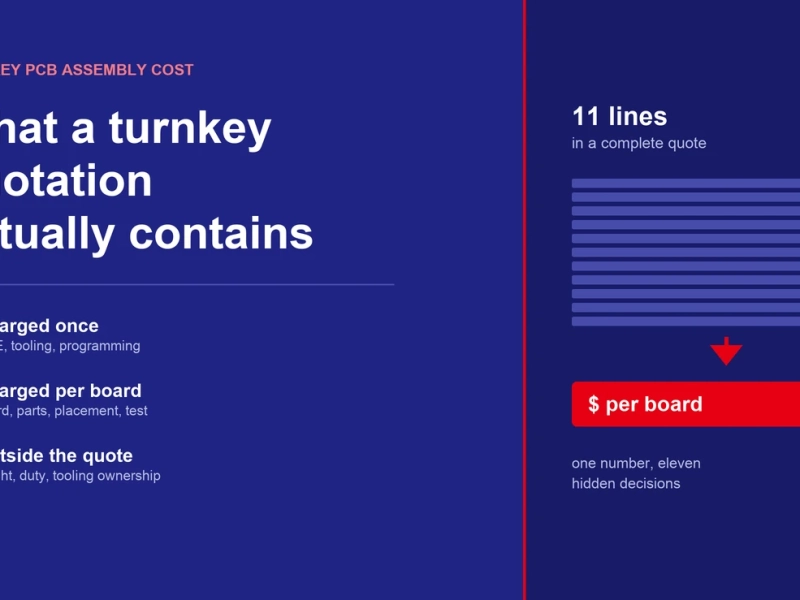
The turnkey PCB assembly service page sets out the full scope, and component purchasing covers BOM review, supply channels and substitution approval. If the open question is what the quotation should contain, the cost breakdown guide covers the eleven lines; if it is how to submit the package, the RFQ checklist covers the files.
Is full turnkey the same as turnkey PCB assembly? In practice, yes. "Turnkey" on its own almost always means full turnkey, with the supplier buying the boards and components; "full turnkey" appears only when a writer needs to distinguish it from partial or consigned builds. The scope is set out on our turnkey PCB assembly page.
Can we switch models between builds? Yes, and many projects do — full turnkey for the prototype, partial turnkey for production where you hold an allocation, or consigned for a build where the customer owns the material. What must not change silently is the line-level responsibility list. If the model changes, the list changes with it, and the quotation has to be reissued.
Who pays for a component that fails after assembly? It depends on who bought it. On a supplier-purchased line, the supplier can pursue a claim against its own purchase and can trace the lot. On a customer-supplied line, the lot came in your kit, so the claim is yours unless the failure is attributable to assembly — which is why first-article inspection and a defined failure-analysis path matter more on consigned builds.
Can we consign some parts and let the supplier buy the rest? That is partial turnkey, and it is the most common arrangement in practice. The important detail is that the split is documented per BOM line and included in the quotation, not agreed verbally.
Does partial turnkey cost more than full turnkey? Usually the conversion cost is higher per board, because the supplier loses the handling margin on the lines it does not buy and still has to verify the ones you send. Whether the total is higher depends on whether your buying price on the consigned lines beats the supplier's. For most low-volume buyers it does not.
Have a build where the supply model is still open?
Send the BOM, Gerber data and quantity with a note on which lines you want to control. KnownPCBA reviews the split, flags the lines where consigning is likely to cost more than it saves, and responds with a quotation that states the responsibility for every line. Start your project.
Proven by 7 industries, 4000+ customer projects
Please contact us at sales@knownpcb.com, ask for engineering support here or use the form below to reach out to KnownPCB | Get In Touch Today |